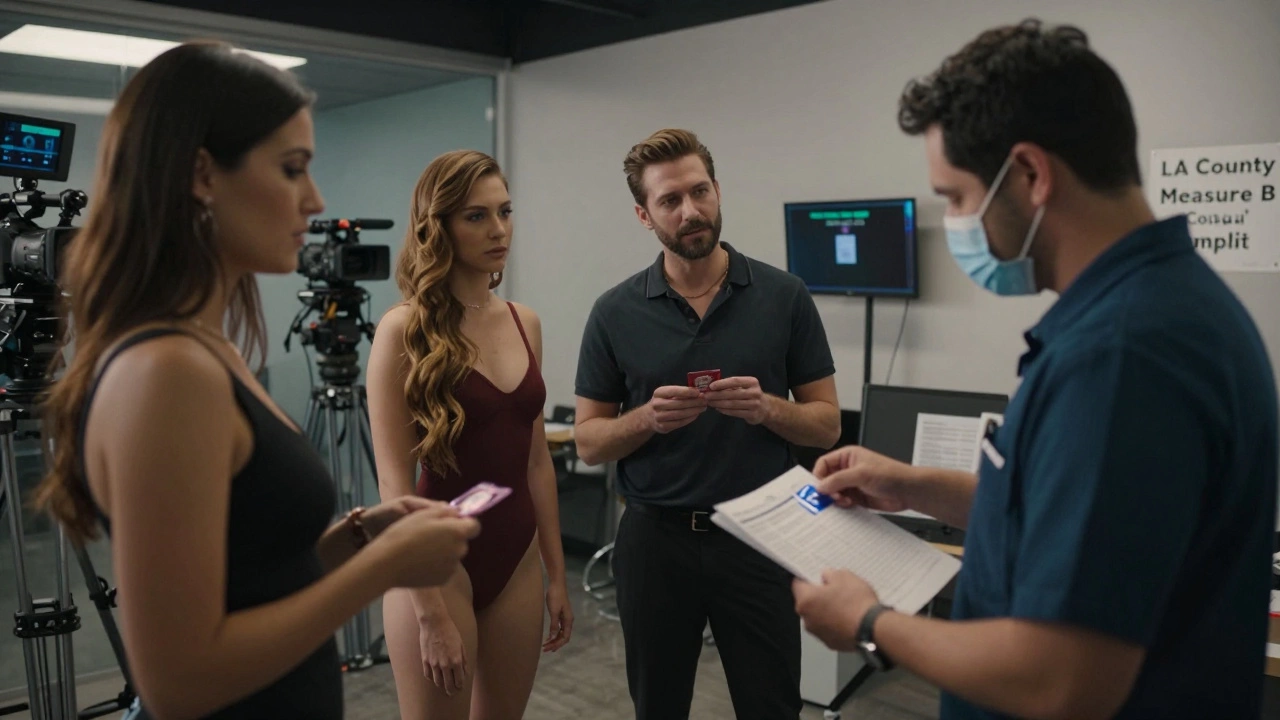
It’s 2025, and the adult film industry in Los Angeles County is still feeling the ripple effects of Measure B - the law that made condoms mandatory for performers during filming. No exceptions. No loopholes. If you’re shooting a scene in LA County, you’re wearing a condom. It’s not a suggestion. It’s the law. And while some people thought this was just a temporary crackdown, it’s now been in place for over a decade, reshaping how adult films are made, marketed, and even watched.
Some fans still remember the early days of online porn - raw, unfiltered, and often without protection. But after a string of HIV outbreaks in the late 2000s, the industry faced a reckoning. Performers started getting sick. Studios got sued. Public trust cracked. That’s when Measure B passed in 2012. It didn’t just ask for condoms - it required them, enforced them, and fined violators up to $1,000 per incident. And yes, that includes every single scene, no matter how brief. Even if it’s just a kiss. Even if it’s a solo shot. You need proof of testing and proof of condom use. It’s strict. But it’s also the reason the industry hasn’t had a major outbreak since.
Outside of California, things are different. In Nevada, brothels are legal, and performers aren’t required to use condoms during private sessions - though they’re still tested regularly. In Europe, regulations vary wildly. In France, for example, adult film production is largely unregulated, and performers often rely on personal discretion. Some even travel there for shoots. If you’re curious about how the scene operates in Paris, you might come across terms like escort'paris - though that’s a different world entirely. One is about health and safety. The other is about companionship and social dynamics. Don’t confuse them.
How Measure B Changed the Industry
Before Measure B, studios used to rely on a voluntary testing system run by the Adult Performer Advocacy Committee (APAC). Performers got tested every 14 days. It worked - mostly. But when one person slipped through the cracks, the whole system could collapse. One positive test meant a shutdown. Studios lost money. Performers lost work. Fans lost access to content.
Measure B turned that model upside down. Now, every production company must file a permit with the LA County Department of Public Health. They must show proof of condom use for every scene. They must keep records for five years. They must allow random inspections. And they must pay for the testing themselves - not the performers. That’s a big deal. Before, performers often paid out of pocket for tests, sometimes over $200 each. Now, the burden falls on the studio.
That shift changed who could afford to produce content. Big studios with deep pockets adapted. Small indie creators? Many couldn’t keep up. The number of new productions in LA dropped by nearly 60% in the first three years after Measure B. Some moved to states like Nevada or Georgia, where rules are looser. Others went fully digital - using CGI, deepfakes, or AI-generated scenes to avoid the legal mess altogether.
What Performers Really Think
Not everyone hates condoms. Many performers say they feel safer now. Take Mia, a performer who’s been in the industry since 2008. She got HIV in 2010 - not from a scene, but from a personal relationship. She went public about it in 2015. “I didn’t want anyone else to go through what I did,” she told Rolling Stone in 2023. “Condoms aren’t sexy, but they’re the only thing keeping us alive.”
Others aren’t as supportive. Some say the law pushed the industry underground. “Now, if you want to film without condoms, you do it in someone’s backyard,” says Tyler, a former director. “No permits. No tests. No oversight. That’s more dangerous than Measure B ever was.”
There’s also the issue of performance. Some performers argue that condoms reduce sensation, which affects the authenticity of scenes. That’s a real concern - but it’s not a health one. It’s a creative one. And studios have adapted. They’ve developed thinner, more sensitive condoms. They’ve changed lighting and camera angles to make the difference less obvious. They’ve even started using internal condoms (female condoms) for certain scenes to give performers more control.

How It Affects You - The Viewer
You might be wondering: does this even matter to me? If I’m just watching, why should I care?
Here’s the truth: you’re already affected. The content you watch today is shaped by this law. The rise of AI porn? That’s partly because real performers are harder to hire under Measure B. The boom in amateur content on platforms like OnlyFans? That’s because those creators operate outside LA County’s jurisdiction. They don’t need permits. They don’t need condoms. They don’t need testing. And yes - that’s riskier.
Also, the law changed how porn is marketed. You won’t see “bareback” or “no condom” tags on major sites like Pornhub or XVideos anymore. Those terms are banned from search results. Sites that used to promote “real sex” now have to label content as “compliant” or “Measure B approved.” It’s not sexy marketing - but it’s honest.
And if you’re looking for content that feels more “real,” you might be tempted to search for alternatives. That’s where terms like escorte gitl come in - though again, that’s not about filming. It’s about personal encounters. Don’t mistake one for the other. One is regulated. The other is not. One has health protocols. The other doesn’t.
What’s Next? AI, Deepfakes, and the Future of Porn
The adult industry is at a crossroads. On one side, you have real performers, protected by law, but limited in creative freedom. On the other, you have AI-generated content that’s cheap, fast, and completely unregulated.
Companies like Sora and Runway are already generating realistic porn scenes from text prompts. No performers. No condoms. No tests. No laws. Just pixels. And it’s growing fast. In 2024, AI-generated adult content made up 18% of all downloads on major platforms - up from 2% in 2020.
Some say this is the end of real porn. Others say it’s the only way forward. But here’s the catch: AI porn doesn’t just replace performers - it replaces accountability. There’s no one to test. No one to protect. No one to sue if something goes wrong.
And that’s why Measure B still matters. It’s not just about condoms. It’s about responsibility. It’s about treating performers as human beings, not just content. It’s about saying: if you’re going to make this stuff, you have to do it safely.
Even if you’re not a performer, you’re part of the system. Your clicks fund it. Your views shape it. Your silence lets it evolve - for better or worse.
Is This Law Working?
Let’s look at the numbers. Since Measure B passed, there have been zero new HIV cases linked to adult film production in LA County. Zero. That’s a decade without a single transmission from a set. That’s more than any other major industry can claim.
STIs like gonorrhea and chlamydia? Those still pop up - but they’re caught early because of the mandatory testing. Performers get tested every 14 days. That’s more frequent than most people get checked for anything. And if someone tests positive? They’re pulled from sets immediately. No second chances. No waiting.
Compare that to the rest of the world. In places without rules, outbreaks still happen. In 2023, a cluster of STIs was traced back to a shoot in Eastern Europe. No one knew who was infected until it was too late. That’s the difference between regulation and chaos.
Measure B isn’t perfect. But it’s the most successful public health intervention the adult industry has ever seen.
Final Thoughts: You Can Still Watch - But Now You Know
So, will you keep watching? Maybe. Maybe not. But now you know why the content looks different. Why the tags have changed. Why some performers are harder to find. Why AI is taking over.
You don’t have to like the law. But you should respect it. Because behind every scene - even the ones that feel fake - there’s a person. And that person deserves to be protected.
And if you’re out there looking for something else - something more personal - you might stumble across terms like escord paris. But remember: that’s not the same world. One is about safety. The other is about choice. Don’t mix them up.